 Jeremy Norman’s
HistoryofInformation.com Exploring the History of Information and Media through Timelines
Jeremy Norman’s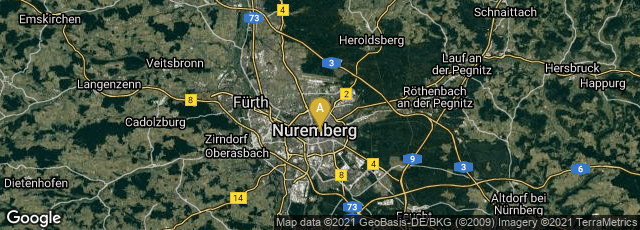

A: Mitte, Nürnberg, Bayern, Germany
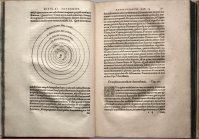
Just before his death, in 1543 Nicolaus Copernicus's De revolutionibus orbium coelestium was published in Nuremberg. De revolutionibus set out Copernicus's revolutionary theory of the heliocentric universe—that the earth and other planets revolve around the sun. The Copernican Revolution, however, was not completed until about one hundred years after the publication of De revolutionibus.
"Copernicus initially outlined his system in a short, untitled, anonymous manuscript that he distributed to several friends, referred to as the Commentariolus. A physician's library list dating to 1514 includes a manuscript whose description matches the Commentariolus, so Copernicus must have begun work on his new system by that time. Most historians believe that he wrote the Commentariolus after his return from Italy, possibly only after 1510. At this time, Copernicus anticipated that he could reconcile the motion of the Earth with the perceived motions of the planets easily, with fewer motions than were necessary in the Alfonsine Tables, the version of the Ptolemaic system current at the time.
"Observations of Mercury by Bernhard Walther (1430–1504) of Nuremberg, a pupil of Regiomontanus, were made available to Copernicus by Johannes Schöner, 45 observations in total, 14 of them withlongitude and latitude. Copernicus used three of them in De revolutionibus, giving only longitudes, and erroneously attributing them to Schöner. Copernicus' values differed slightly from the ones published by Schöner in 1544 in Observationes XXX annorum a I. Regiomontano et B. Walthero Norimbergae habitae, [4°, Norimb. 1544].
"Remarkably, a manuscript of De revolutionibus in Copernicus' own hand has survived. After his death, it was given to his pupil, Rheticus, who for publication had only been given a copy without annotations. Via Heidelberg, it ended up in Prague, where it was rediscovered and studied in the 19th century. Close examination of the manuscript, including the different types of paper used, helped scholars construct an approximate timetable for its composition. Apparently Copernicus began by making a few astronomical observations to provide new data to perfect his models. He may have begun writing the book while still engaged in observations. By the 1530s a substantial part of the book was complete, but Copernicus hesitated to publish.
"In 1539 Georg Joachim Rheticus, a young mathematician from Wittenberg, arrived in Frauenburg (Frombork) to study with him. Rheticus read Copernicus' manuscript and immediately wrote a non-technical summary of its main theories in the form of an open letter addressed to Schöner, his astrology teacher in Nürnberg; he published this letter as the Narratio Prima in Danzig in 1540. Rheticus' friend and mentor Achilles Gasser published a second edition of the Narratio in Basel in 1541. Due to its friendly reception, Copernicus finally agreed to publication of more of his main work—in 1542, a treatise on trigonometry, which was taken from the second book of the still unpublished De revolutionibus. Rheticus published it in Copernicus' name.
"Under strong pressure from Rheticus, and having seen that the first general reception of his work had not been unfavorable, Copernicus finally agreed to give the book to his close friend, Bishop Tiedemann Giese, to be delivered to Rheticus in Wittenbergfor printing by Johannes Petreius at Nürnberg (Nuremberg). It was published just before Copernicus' death, in 1543(Wikipedia article on De revolutionibus, accessed 11-11-2013).
Because of the unusually extended delay between the publication of the Copernican theory and its acceptance by the scientific community, for many years historians believed that the book was not widely read at the time of its first publication. However, "Owen Gingerich, a widely recognized authority on both Nicolaus Copernicus and Johannes Kepler, disproved that belief after a 35-year project to examine every surviving copy of the first two editions. Gingerich showed that nearly all the leading mathematicians and astronomers of the time owned and read De revolutionibus; however, his analysis of the marginalia shows that they almost all ignored the cosmology at the beginning of the book and were only interested in Copernicus' new equant-free models of planetary motion in the later chapters" (Wikipedia article on De revolutionibus accessed 11-20-2008).
Up until the second decade of the seventeenth century the Church ignored the revolutionary implications of Copernicus's heliocentric theory of the solar system, partly because his system was useful for calendrical purposes, partly because of Andreas Osiander's anonymous and unauthorized preface "Ad lectorem" (long thought to be by Copernicus himself) presenting the heliocentric system as no more than a convenient calculating device, and partly because Copernicus himself "was annoyingly vague concerning whether or not he believed in the reality of his system" (Gingerich, p. 49). However, Kepler's insistence in his Astronomia nova (1609) on the possible physical reality of Copernicus's system and his revelation of Osiander as the true author of "Ad lectorem," coupled with Galileo's public support of Copernicanism and his attacks on the Aristotelian-Catholic view of the heavens (beginning with his Letter on sunspots [1613]), alerted the ecclesiastical establishment to the dangers to its own authority inherent in the new system. In 1616 the Church placed De revolutionibus on the Index librorum prohibitorum "until suitably corrected," and, for the only time in its history, spelled out the expected alterations to be made in the text. This belated attempt at censorship was a failure, however: the census of copies published by Owen Gingerich shows that only one copy in twelve contains the prescribed changes, and that copies in France, Spain and Protestant Europe largely escaped correction.
In November 2013 a digital facsimile of the 1543 first edition of De revolutionibus was available from the Rare Book Room at this link.
Gingerich, "The Censorship of Copernicus's De revolutionibus," Annali dell'Istituto e Museo di Storia della Scienza di Firenze, Fasicolo2 (1981).
Gingerich, An Annotated Census of Copernicus' De Revolutionibus (Nuremberg, 1543 and Basel, 1566). (2002). This 400-page work will remain a landmark in the history of bibliography. Its Preface begins as follows on p. [vii]:
"You have before you something almost unique in the annals of bibliography: an attempt to described the provenance, annotations, and condition of all surviving sixteenth-century copeis of a major Renaissance text. This census lists 277 copies of the first edition of Nicolaus Copernicus' pioneering masterpiece, De revolutionibus orbium coelestium libri sex (Nuremberg, 1543), and 324 copies of the second edition (Basel, 1566). Its compilation has taken three decades, the worldwide cooperation of librarians, dealers, and collectors, and literally hundreds of thousands of miles of travel."
[Incidentally, for those interested in the most esoteric bibliographical minutiae, there are two issues of Gingerich's bibliography. The first, printed on thicker paper, contains a typographical error on the upper cover, substituting the word "en" for "and" in "(Nuremberg, 1543 and Basel, 1566)". In the second issue printed on thinner paper this rather prominent but small error was corrected.]
Hook & Norman, The Haskell F. Norman Library of Science and Medicine (1991) no. 516.