 Jeremy Norman’s
HistoryofInformation.com Exploring the History of Information and Media through Timelines
Jeremy Norman’s

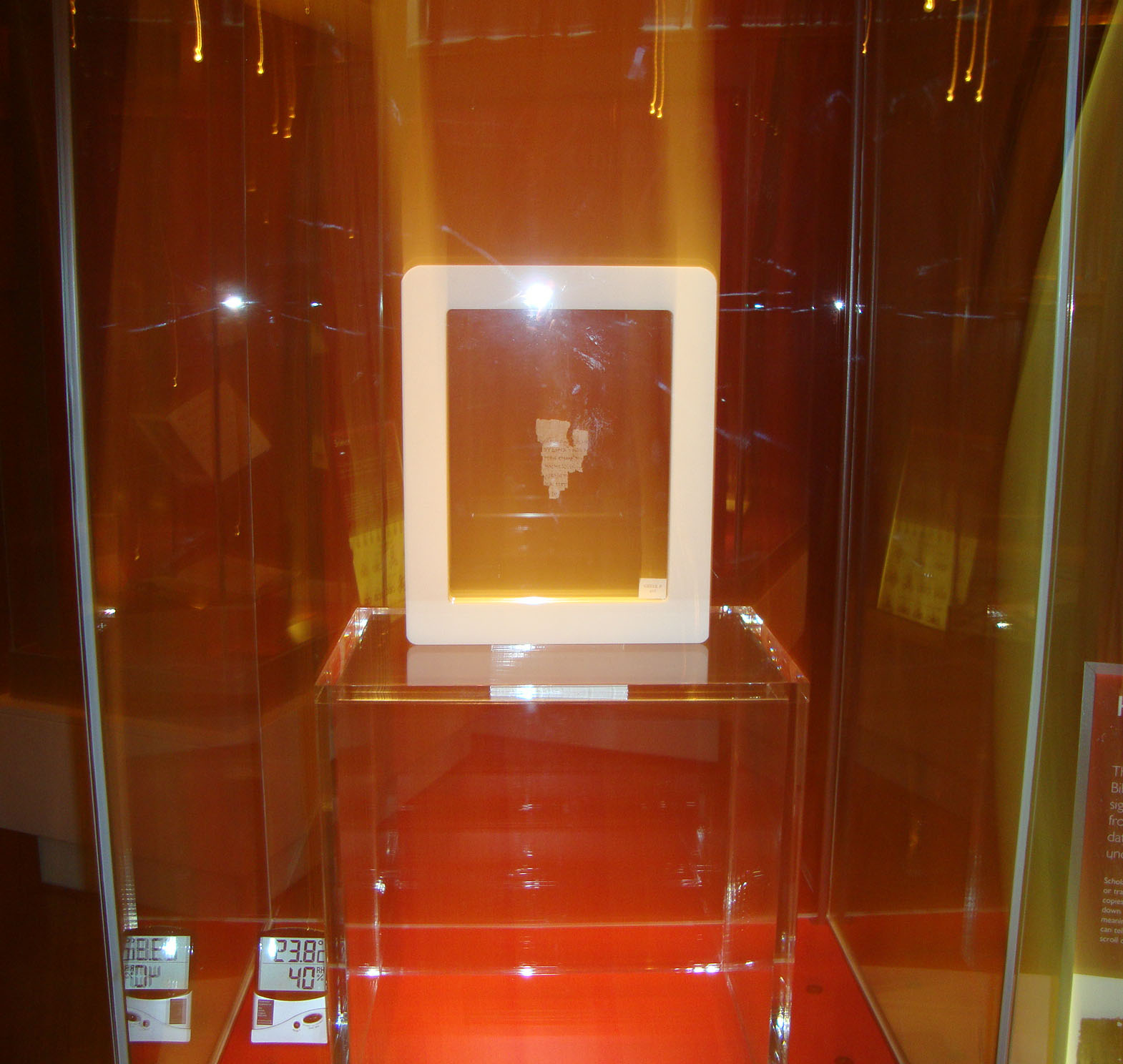
The Saint Johns fragment, Rylands Library LibPapyrus P52, as it is displayed and protected in the John Rylands Library, Manchester. The fragment measures only 8.9 x 6 cm. at its widest.
Dating from between 100 and 160 CE, the Saint John Fragment, Rylands Library Papyrus P52, a fragment from a papyrus codex written in Greek, is generally accepted as the earliest extant record of a canonical New Testament text. The front of the fragment (recto) contains lines from the Gospel of John 18:31-33, and the back (verso) contains lines from verses 37-38. The fragment measures only 3.5 by 2.5 inches (9 by 6.4 cm) at its widest. It is conserved at the John Rylands Library at Manchester.
" . . . the dating of the papyrus is by no means the subject of consensus among critical scholars. The style of the script is strongly Hadrianic, which would suggest a date somewhere between 125 and 160 CE. But the difficulty of fixing the date of a fragment based solely on paleographic evidence allows for a range of dates that extends from before 100 CE past 150 CE.
"The fragment of papyrus was among a group acquired on the Egyptian market in 1920 by Bernard Grenfell. The original transcription and translation of the fragment of text was not done until 1934, by Colin H. Roberts. Roberts found comparator hands in papyri then dated between 50 CE and 150 CE, with the closest match of Hadrianic date. Since the contents would unlikely have been written before circa 100 CE he proposed a date in the first half of the second century. Over the 70 years since Roberts' essay, the estimated ages of his particular comparator hands have been revised (in common with most other undated antique papyri) towards dates a couple of decades older; while other comparator hands have subsequently been discovered with possible dates ranging into the second half of the second century" (Wikipedia article on Rylands Library Papyrus 52).
