 Jeremy Norman’s
HistoryofInformation.com Exploring the History of Information and Media through Timelines
Jeremy Norman’s
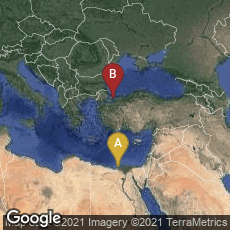
A: Alexandria Governorate, Egypt, B: İstanbul, Turkey
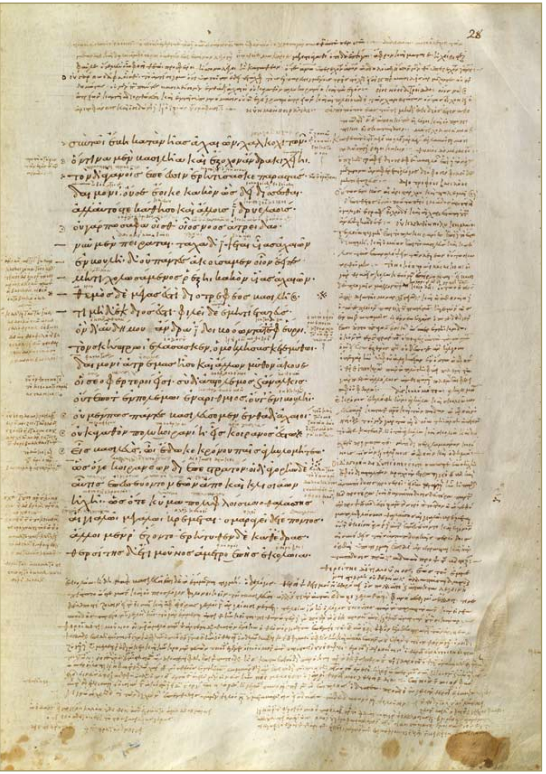
Folio 28r of Venetus A reproduced from Dué, Recapturing a Homeric Legacy (2009) 63.

The most famous Greek manuscript of the Homeric Iliad, Venetus A (Marcianus Graecus Z. 454 [=822]), is regarded by some as the best text of the epic poem. It also contains several layers of annotations, glosses, and commentaries known as the "A scholia." These are thought to preserve editorial comments made by scholars at the Royal Library of Alexandria, as well as scholia accumulated by late antique annotators and philologists until the manuscript was written at Constantinople during the Macedonian Renaissance. The manuscript, also includes a summary of the early Greek Epic Cycle which is considered the most important source of information on those lost poems.
At the end of most of the books of the poem there is a subscription, attributing many of the scholia to four Homeric scholars from antiquity. This was translated as follows:
"Alongside the text lie the Signs of Aristonicus, and Didymus' work On the Edition of Aristarchus, as well as some things from the Prosody of Herodian and Nicanor's On Punctuation."
The first scholar mentioned in the subscription, the Greek grammarian Aristonicus (Ἀριστόνικος Aristonikos) of Alexandria, lived during the reigns of Augustus and Tiberius. He taught at Rome, and wrote commentaries and grammatical treatises. Most of his works were related to the Homeric poems, including On the Wanderings of Menelaus (περὶ τῆς Μενελάου πλάνης), On the Critical Signs of the Iliad and Odyssey (περὶ τῶν σημείων τῆς Ἰλιάδος καὶ Ὀδυσσείας), on the marginal signs by which the Alexandrian critics used to mark suspected or interpolated verses in the Homeric poems and in Hesiod's Theogony, and On Ungrammatical Words (ἀσυντάκτων ὀνομάτων βιβλία), a work of six books on irregular grammatical constructions in Homer. These and some other works are for the most part lost, except for fragments preserved in the scholia of Venetus A.
The second scholar mentioned, Greek scholar and grammarian Didymus Chalcenterus (Δίδυμος χαλκέντερος Didymos chalkenteros, "Didymus bronze-guts"), flourished in the time of Cicero and Augustus. His surname "bronze-guts" came from his nearly incredible productivity: he was said to have written so many books that he was unable to recollect what he had written in earlier ones, and so often contradicted himself. (Athenaeus records that he wrote 3500 books; Seneca estimated that he wrote 4000.) As a result Didymos acquired the additional nickname βιβλιολάθης "book-forgetter". Didymos taught in Alexandria and Rome, and is chiefly important as having introduced Alexandrian learning to the Romans. A follower of the school of the Alexandrian grammarian and editor Aristarchus of Samothrace (Ἀρίσταρχος), Didymos wrote a treatise on Aristarchus' edition of Homer entitled On Aristarchus' recension (περὶ τῆς Ἀριστάρχου διορθωσέως), fragments of which are preserved in Venetus A.
The third scholar cited, Aelius Herodianus (Αἴλιος Ἡρωδιανός) or Herodian, was one of the most celebrated grammarians of Greco-Roman antiquity. He was born in Alexandria, and from there he seems to have moved to Rome, where he gained the favor of the emperor Marcus Aurelius, to whom he dedicated a work on prosody. He is usually known as Herodian except when there is a danger of confusion with the historian also named Herodian.
Lastly, the Greek grammarian Nicanor (Νικάνωρ) Stigmatias lived during the reign of Hadrian in the early 2nd century. According to the Suda he came from Alexandria; according to Stephanus of Byzantium he came from Hierapolis. The Suda records that Nicanor acquired the nickname stigmatias (στιγματίας, punctuated) because of his concentration on punctuation. His scholia on the elucidation of Homer's epics through punctuation are extensively quoted in the Venetus A.
"Scholars refer to the work of these men as the 'four-man commentary,' or VMK (from the German Viermännerkommentar). The repeated subscriptions in the Venetus A identify the areas of Homeric studies to which each of the four contributed. Aristonicus wrote on the topic of editorial symbols attached to the text. Herodian wrote on questions of prosody, that is poetic meter. Nicanor wrote about punctuation. And Didymus wrote about the earlier editorial work of the Alexandrian scholar Aristarchus.
"A certain category of scholia, while related to the VMK, has been separately identified and named the 'D Scholia.' These were once thought to have come originally from Didymus, hence their name, but this view is no longer generally accepted. The D Scholia appear on several Byzantine and medieval manuscripts of the Iliad and generally contain information about mythology, the meanings of obscure words and pieces of allegorical interpretation. On the Venetus A the D Scholia appear as interlinear notes written in a semiuncial script and are largely 'glosses,' short defintions of words in the poems. One of the most interesting aspects of the D Scholia is their lemmata, the Homeric passages that a scholion may quote before commenting. In many cases, these lemmata do not match the Homeric text that appears in the manuscript. Thus, these scholia may offer insights into alternative versions of the text, other examples of traditional material that fell out of the common text of the Iliad by the ninth century, but are preserved here and there in brief quotations by the scholiasts, the writers of these marginal notes.
"Still other scholia on our manuscript derive from the work of the scholar and philosopher Porphyry, who lived during the third century CE. Among his writings, many of which had to do with Platonic philosophy, was a treatise entitled 'Homeric Questions' (Ομηικα Ζητηματα, Homerika Zetemata, or in its more commonly given Latin translation, Quaestiones Homericae). This work exists only in a fragmentary state in the Vatican Library (Vaticanus Graecus 305), and the rest of what we know of its contents comes from close reading of various scholia on Homeric manuscripts. Porphyri's work is an example of the late-antique genre of Ζητηματα, which is generally translated 'Questions,' consisting of inquiries into various topics with (often) varying and debatable answers. Ancient works of Ζητηματα covered ethical, legal, and historical topics, and Porphyry's work on Homer is one of the few examples of literary 'Questions,' consisting of inquries into various topics with (often) varying and debatable answers. The scholiastic material that comes from this work is valuable for a number of reasons, although its value has not always been appreciated. For much of the 19th and 20th centuries, scholars dismissed Porphyry as telling us little about Homeric poetry itself, but much about the literary 'parlor games' played by intelligent aristocrats in antiquity. But these scholia preserve some observations on Homeric poetry made by Aristotle and Plato, which in turn can tell us about the particular vocabulary these ancient thinkers used when they discussed epic poetry, and thus much about the ancient experience of listening to this poetry.
"Finally, there are scholia related to a group known as the 'bT' scholia. These get their name from the Townley Manuscript of the Iliad, an eleventh-century codex now in the British Museum (BM, Burney 86); this manuscript is believed to have been one of several copied from an even older manuscript, which is now lost, to which scholars refer by the siglum 'b', hence the 'bT' scholia. These scholia, which may also be derived from the work of Porphyry, offer explanations of thematic matters found in the Iliad, cultural practices, questions of cosmology or theology, and so forth. These scholia have not enjoyed a high reputation among scholars. Their most famous critic, K. Lehrs, said that 'not one word in them is to be believed," (nullum unum verbum iis credendum esse). But more recent students of this material have found them more valuable, suggesting that they offer important insight into how the ancient Greeks understood Homer, but also provide more access to the work of Aristarchus at the Library of Alexandria.
"There is diagreement among scholars as to how and when the VMK was created (proposed dates ranged from the fourth to seventh centuries CE) and whether or not they were created by the same editor. The 20th century scholars most interested in the Homeric scholia believed that the VMK tradition was combined with the D Scholia and the bT Scholia at some time during the eighth century, about two centuries before our nameless scribe produced the elaboratately annotated manuscript we call the Venetus A" (Blackwell & Dué, "Homer and History in the Venetus A," Recapturing a Homeric Legacy. Images and Insights From the Venetus A Manuscript of the Iliad, Dué ed. [2009] 7-9).
How and when Venetus A was transported to Italy is uncertain. At one point it was thought that Giovanni Aurispa brought it there, as in 1424, he mentioned four volumes which he had brought back from Greece in a letter to Ambrogio Traversari in Venice:
Aristarchum super Iliade in duobus voluminibus, opus quoddam spatiosum et pretiosissimum; aliud commentum super Iliade, cuius eundem auctorem esse puto et illius quod ex me Nicolaus noster habuit super Ulixiade.
Aristarchus on the Iliad in two volumes, a large and very precious work; another commentary on the Iliad; I think Aristarchus was the author of that, as well as of the one on the Odyssey that our friend Niccolò Niccoli got from me.
This has been interpretted as a reference to the codices of the Iliad known as Venetus A and B. However, it has also been argued that the two volume commentary referred to was the commentary by the twelfth century Byzantine scholar and archbishop Eustathius of Thessalonica (Laurentianus LIX 2 and 3) attested in Florence a century later in the library of Cardinal Giovanni de' Medici, and now in the Laurentian Library.
Eventually, Venetus A came into the possession of Greek immigrant scholar, and book collector Cardinal Basileios Bessarion (Βασίλειος Βησσαρίων), who collected a library of 482 Greek manuscripts and 264 Latin manuscripts before, and especially after, the fall of Constantinople in 1453. Among Bessarion's library was the only complete text of Athenaios' Deipnosophistai; the autograph of Planudes' Greek Anthology; and Venetus A and B. In 1468 Bessarion donated his library to the Republic of Venice; he continued to add to it until his death in 1472. By preserving so many Greek texts Bessarion became one of those most influential on the revival of Greek literature during the Renaissance. Bessarion's library became the core of the Biblioteca Marciana, which since 1554 has been housed to the building designed for it by Sansovino, the Biblioteca Sansoviniana.
With respect to the study of Venetus A, it is known that Martinus Phileticus used the manuscript as a source in the 1480s, followed by Vettore Fausto in 1546 or 1547. After that, Venetus A was largely forgotten until French philologist Jean-Baptiste-Gaspard d'Ansse de Villoison rediscovered and published it, along with the "B scholia" from Venetus B, in his book Ilias Homeri to Veteris Codicis Veneti fidem-recensita; scholia in eam antiquissima, eodem Code ex nunc primum eruta (Venice, 1788). This was the first publication of any Iliadic scholia other than the "D" scholia (the scholia minora). Because of the complexity of the writing on each page of Venetus A, Villoison's work represented a very impressive work of scholarship and a high level of technical achievement in the printing of Greek. In April 2014 high resolution images of each page in Villoison's 716-page work were available from the Center for Hellenic Studies at Harvard at this link.
Once available to scholars, the A and B scholia were a catalyst for several new ideas from the scholar Friedrich August Wolf. In reviewing Villoison's edition, Wolf realized that these scholia proved conclusively that the Homeric epics had been transmitted orally for an unknown length of time before they were written down. This led to his seminal work, Prolegomena ad Homerum, which set the agenda for much of later Homeric scholarship.
In 1901 Venetus A was reproduced in photographic facsimile as Homeri Ilias cum scholiis. Codex Venetus A, Marcianus 454. Phototypice editus. Praefatus est Dominicus Comparetti, and published in Leiden by A. W. Sijthoff. However, the technology of the time could not reproduce all of the small script in the manuscript legibly.
More than 100 years later, in May 2007 both Venetus A and Venetus B were photographed at high resolution, using a Hasselblad H1 camera with a 39 megapixel Phase One P45 digital back, at the Biblioteca Marciana. The availability of truly legible images of all the text in these manuscripts resulted in insights published in 2009 as Hellenic Studies 35, entitled Recapturing a Homeric Legacy. Images and Insights From the Venetus A Manuscript of the Iliad, edited by Casey Dué, and published by the Center for Hellenic Studies at Harvard. In April 2014 this book was available online from homermultitext.org. Also in April 2014 high resolution images of each page in Venetus A and B were available from the same source at this link.
The Homer Multitext project also made available the Greek texts of Venetus A and B online. The site stated that "This site publishes editions of texts from Byzantine manuscripts using the Canonical Text Services protocol. The service is primarily intended for automated use by other computer programs, but you can follow the links below to to browse and read texts." The site also made available images of individual pages of the Townley Homer. However, in April 2014 a much easier to use digital facsimile of that manuscript was available from the British Library at this link.
(This entry was last revised on 04-26-2014.)