 Jeremy Norman’s
HistoryofInformation.com Exploring the History of Information and Media through Timelines
Jeremy Norman’s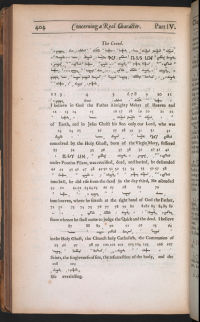
Wilkins was concerned to make his "character" or writing system elegant and concise, as well as to ensure that it was suitable for universal application. According to the ODNB, Joseph Moxon, author of the first comprehensive printer's manual, created the typographic symbols in which Wilkins universal language was printed.

A: London, England, United Kingdom
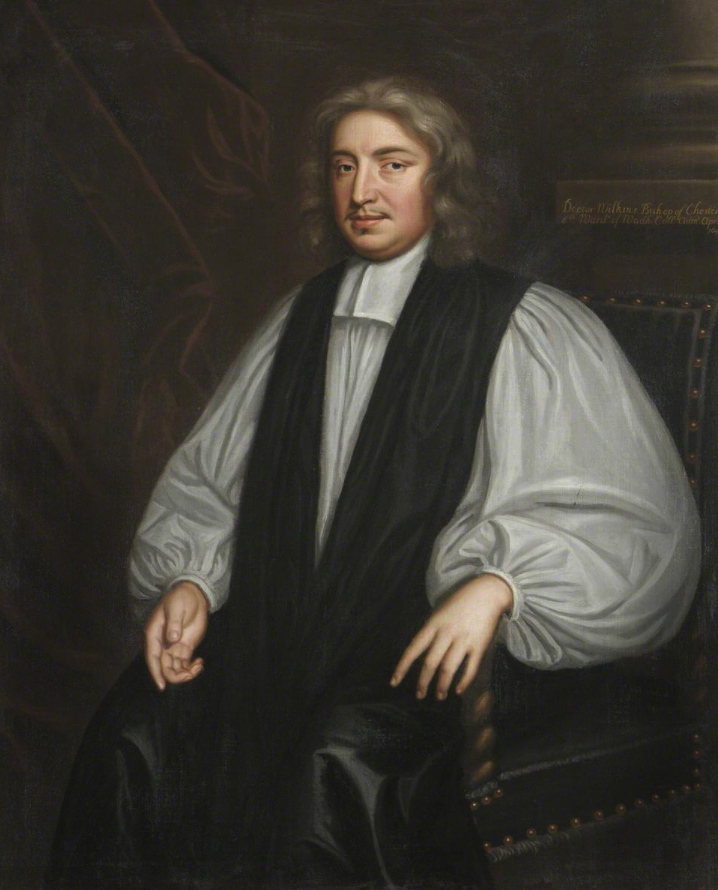
In An Essay towards a Real Character and a Philosophical Language English clergyman and natural philosopher John Wilkins attempted to create a universal, artificial language, based upon an innovative classification of knowledge, by which scholars and philosophers as well as diplomats, scholars, and merchants, could communicate. Wilkins intended his "universal language" as a supplement to, rather than a replacement for, existing "natural" languages. His scheme has been called ingenious but completely unworkable.
In this book Wilkins also called for the institution of a "universal measure" or "universal metre," which would be based on a natural phenomenon rather than royal decree, and would also be decimal rather than the various systems of multipliers, often duodecimal, that coexisted at the time. The meter or metre would not gain traction until after the French Revolution.
"During the final stages of work on his Essay Wilkins lost his house and most of his belongs and papers, in the great fire of London, but being eager to complete his scheme he enlisted the help of John Ray and Francis Willioughby to improve the botanical and zoological nomenclature. This was a major factor in stimulating Ray to develop his own classificatory studies. Similarly, Samuel Pepys reported that he helped to draw up a table of naval terms, such as the names of rigging. Even with this and other help, Wilkins admited his scheme's shortcomings and called upon the Royal Society to improve it. Although various fellows of the society spoke highly of the scheme for a while, only Robert Hooke showed any lasting commitment to it, and the committee established to improve on the Essay never reported. Scholars have argued about the major influences upon Wilkins's linguistic studies. There is little evidence that the universal language schemes of Amos Comenius played any significant role; Mersenne may have been an inspiration but George Dalgarno, to help whom Wilkins had begun to draw up classifactory tables of knowledge after 1657, was a more dirrect influence" (ODNB).
By "real character" Wilkins meant:
"an ingeniously constructed family of symbols corresponding to an elaborate classification scheme developed at great labor by Wilkins and his colleagues, which was intended to provide elementary building blocks from which could be constructed the universe's every possible thing and notion. The Real Character is emphatically not an orthography in that it is not a written representation of oral speech. Instead, each symbol represents a concept directly, without (at least in the early parts of the Essay's presentation) there being any way of vocalizing it at all; each reader might, if he wished, give voice to the text in his or her own tongue. Inspiration for this approach came in part from (partially mistaken) accounts of the Chinese writing system.
"Later in the Essay Wilkins introduces his "Philospophical Language," which assigns phonetic values to the Real Characters, should it be desired to read text aloud without using any of the existing national languages. (The term philosophical language is an ill-defined one, used by various authors over time to mean a variety of things; most of the description found at the article on "philosophical languages" applies to Wilkins' Real Character on its own, even excluding what Wilkins called his "Philosophical Language")
"For convenience, the following discussion blurs the distinction between Wilkins' Character and his Language. Concepts are divided into forty main Genera, each of which gives the first, two-letter syllable of the word; a Genus is divided into Differences, each of which adds another letter; and Differences are divided into Species, which add a fourth letter. For instance, Zi identifies the Genus of “beasts” (mammals); Zit gives the Difference of “rapacious beasts of the dog kind”; Zitα gives the Species of dogs. (Sometimes the first letter indicates a supercategory— e.g. Z always indicates an animal— but this does not always hold.) The resulting Character, and its vocalization, for a given concept thus captures, to some extent, the concept's semantics.
"The Essay also proposed ideas on weights and measure similar to those later found in the metric system. The botanical section of the essay was contributed by John Ray; . . .
"Jorge Luis Borges wrote a critique of Wilkins' philosophical language in his essay El idioma analítico de John Wilkins (The Analytical Language of John Wilkins). He compares Wilkins’ classification to the fictitious Chinese encyclopedia Celestial Emporium of Benevolent Knowledge, expressing doubts about all attempts at a universal classification. Modern information theory also suggests that it is a bad idea to have words with similar but distinct meanings also sound similar, because mishearings and the resulting confusion would be much more prominent than in real-world languages. In The Search for the Perfect Language, Umberto Eco catches Wilkins himself making this kind of mistake in his text, using Gαde (barley) instead of Gαpe (tulip)" (Wikipedia article on An Essay towards a Real Character and a Philosophical Language, accessed 06-16-2010).