 Jeremy Norman’s
HistoryofInformation.com Exploring the History of Information and Media through Timelines
Jeremy Norman’s

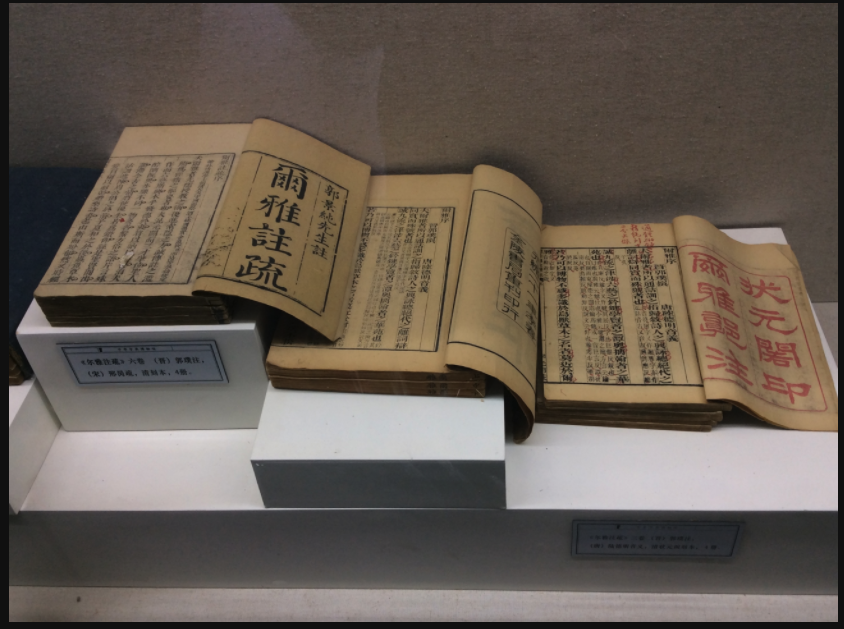
The earliest surviving monolingual dictionary is the Chinese dictionary called the Eyra, produced about 250 BCE.
"The Erya has been described as a dictionary, glossary, synonymicon, thesaurus, and encyclopaedia. Karlgren (1931: 46) explains that the book "is not a dictionary in abstracto, it is a collection of direct glosses to concrete passages in ancient texts." The received text contains 2094 entries, covering about 4300 words, and a total of 13,113 characters. It is divided into nineteen sections, the first of which is subdivided into two parts. The title of each chapter combines shi ("explain; elucidate") with a term describing the words under definition. Seven chapters (4, 8, 9, 10, 12, 18, and 19) are organized into taxonomies. For instance, chapter 4 defines terms for: paternal clan (宗族), maternal relatives (母黨), wife's relatives (妻黨), and marriage (婚姻). The text is divided between the first three heterogeneous chapters defining abstract words and the last sixteen semantically-arranged chapters defining concrete words. The last seven – concerning grasses, trees, insects and reptiles, fish, birds, wild animals, and domestic animals – describe more than 590 kinds of flora and fauna. It is a valuable document of natural history and historical biogeography....
"The book's author is unknown. Although it is traditionally attributed to the Duke of Zhou, Confucius, or his disciples, scholarship suggests that someone compiled and edited diverse glosses from commentaries to pre-Qin texts, especially the Shijing. Joseph Needham et al. (1986: 191) place the Erya's compilation between the late 4th and early 2nd centuries BCE, with the possible existence of some core text material dating back to the 6th century BCE, and the continued additions to the text as late as the 1st century BCE" (Wikipedia article on Eyra, last accessed 9-2020).
