 Jeremy Norman’s
HistoryofInformation.com Exploring the History of Information and Media through Timelines
Jeremy Norman’s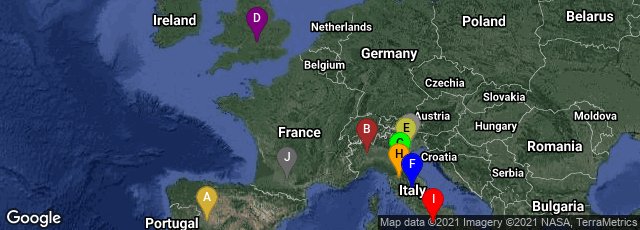
A: Salamanca, Castilla y León, Spain, B: Vercelli, Piemonte, Italy, C: Bologna, Emilia-Romagna, Italy, D: Oxford, England, United Kingdom, E: Padova, Veneto, Italy, F: Perugia, Umbria, Italy, G: Treviso, Veneto, Italy, H: Firenze, Toscana, Italy, I: Napoli, Campania, Italy, J: Toulouse, Occitanie, France
The earliest dated evidence of the pecia system of providing "certified texts" of manuscripts in university bookstores is the Vercelli contract of 1228. This coincided with the foundation of the university at Vercelli, which was "the world's first university funded by public money":
" 'Item habebit commune Vercellarum duos exemplatores, quibus taliter providebit quod eos scolare habere possint, qui habeant exemplantia [exemplaris?] in utroque iure et in Theologia compretentia et correctam tam in text quam in gloxa, ita quod solutio fiat a scolaribus pro exemplis secundum quod convenit ad taxationem Rectorum' ('Item, the commune of Vercelli will provide two exemplatores who are to have exemplaria in both laws and in theology, complete and correct both in text and gloss, so that the scholars may pay for their copies at a price set by the rectors'). This contract was signed on 4 April 1228 between certain masters of the University of Padua who wished to secede from that university and representatives of the commune of Vercelli, who were ready to bid generously in privileges to attract a new university to their city. The University of Padua was then only six years old and it is not credible that in such a short space of time the pecia could have been created there. The University of Padua was formed in 1222 by a secession from the University of Bologna, and it seems to be plain that it was in that older university that the pecia system had its origin about the year 1200.
"The spread of the system
"The pecia system existed in at least eleven universities: at Bologna [founded 1088], Padua [founded 1222], Vercelli, Perugia (founded in 1308), Treviso (1318) and Florence (1349) in Northern Italy: at Salamanca [founded 1134] in Spain (1254) and Naples in Southern Italy (1224); at Paris [founded 1257] and Toulouse [founded 1229] in France; and at Oxford. No trace of it has been found at Salerno, Montpellier, Orléans, Angers, Avignon or Cambridge, or in any of the German or Dutch universities. Actual exemplaria and pecia copies were identified by Destrez from Bologna, Paris, Oxford and Naples, but none from the other seven universities have yet been recognised; and we only know that they provided for the pecia system in their statutes" (Pollard, "The pecia system in the medieval universities," Parkes & Watson, editors, Medieval Scribes, Manuscripts & Libraries. Essays Presented to N.R. Ker [1978] 147-48).
"Generally speaking, the purpose of the system was to provide reliable copies of the works of contemporary scholastic authors in law, theology, philosophy and pastoral aids, and it worked somewhat as follows. A university bookseller (stationarius) would obtain an autograph copy of an author's work, or, if that were hard to read (or if the author were long dead), a fair copy or other reliable exemplar of the work. From this exemplar the stationer made a copy or exemplar of his own on equal quires or pieces (peciae), each one of which was numbered in sequence, so that the stationer, when requested for copies of the text in question, could hire out these pieces in turn for copying to professional writers. . . ." (L. E. Boyle, Peciae, Apopeciae, and a Toronto MS. of the Sententia Libri Ethicorum of Aquinas, in Ganz (ed.) The Role of the Book in Medieval Culture [1986] 71).
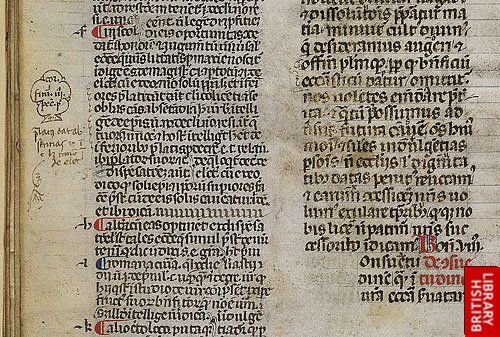
The standard and extensively illustrated monograph on the pecia system remains Destrez, La pecia dans les manuscrits universitaires du XIIIe et du XIVe siècle (1935). This reproduces manuscript pages full-size, which is helpful since the pecia marks are small, and might be illegible if the images were reduced:
"PECIA (var. : petia, pechia, pesia, peça, pecca ; vieux français piece, piès, etc) : L’exemplar est copié, suivant la longueur de l’ouvrage, sur une série plus ou moins grande de cahiers de quatre folios, non reliés, mais laissés indépendants les uns des autres, et dont chacun est appelé unepecia. Primitivement, le mot pecia est probablement un terme de tannerie ou de parcheminerie ; c’est une peau de mouton préparée en vue de l’écriture. Par extension, le morceau ou la feuille de parchemin la plus grande que l’on puisse obtenir de cette pièce, quand on en a rogné les parties extérieures inutilisables, s’appelle aussi une pièce : pecia. Cette feuille est rabattue sur elle-même, puis pliée en deux ; le cahier ainsi obtenu correspond sensiblement à notre format moderne in-4.0 jésus . . . ; c’est un binion, il a deux feuilles doubles, soit huit pages, seize colonnes. On lui donne le nom de pecia. Le mot pecia, pièce, désigne donc dans l ‘industrie du livre, . . . l’unité de cahiers dont se compose l’exemplar" (Destrez, pp. 5-6).
In December 2014 a very useful illustrated summary of the system, including a comprehensive bibliography, and reproductions of several examples of pecia marks, was available in Jean-Luc Deuffic's Bibliologie Médiévale blog at this link.
(This entry was last revised on 12-15-2014.)