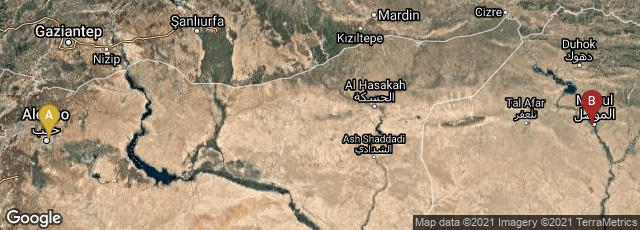
A: Midan, Aleppo, Aleppo Governorate, Syria, B: Hayy An Nabijarjis, Mosul, Nineveh Governorate, Iraq
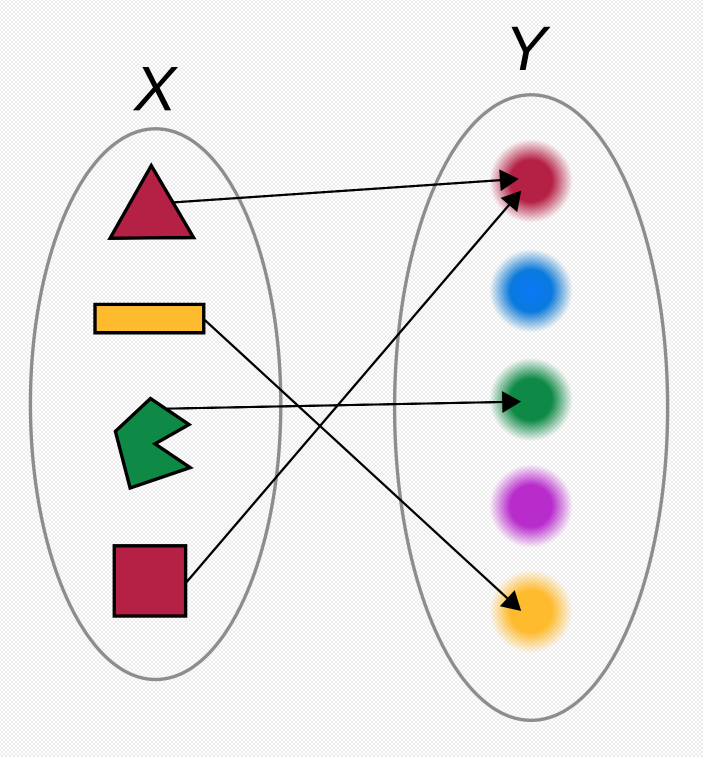
About 1150 Persian mathematician and astronomer of the Islamic Golden Age Sharaf al-Dīn al-Muẓaffar ibn Muḥammad ibn al-Muẓaffar al-Ṭūsī, who taught in Aleppo and Mosul, originated the concept of mathematical function.
"In his analysis of the equation x3 + d = bx2 for example, he begins by changing the equation's form to x2(b − x) = d. He then states that the question of whether the equation has a solution depends on whether or not the 'function' on the left side reaches the value d. To determine this, he finds a maximum value for the function. Sharaf al-Din then states that if this value is less than d, there are no positive solutions; if it is equal to d, then there is one solution; and if it is greater than d, then there are two solutions" (Wikipedia article on Function (mathematics), accessed 03-26-2009)

#/media/File:Function_color_example_3.svg)